


Eternal Sunday
Pet Paw and Nose Balm
Pet Paw and Nose Balm
In stock
Couldn't load pickup availability
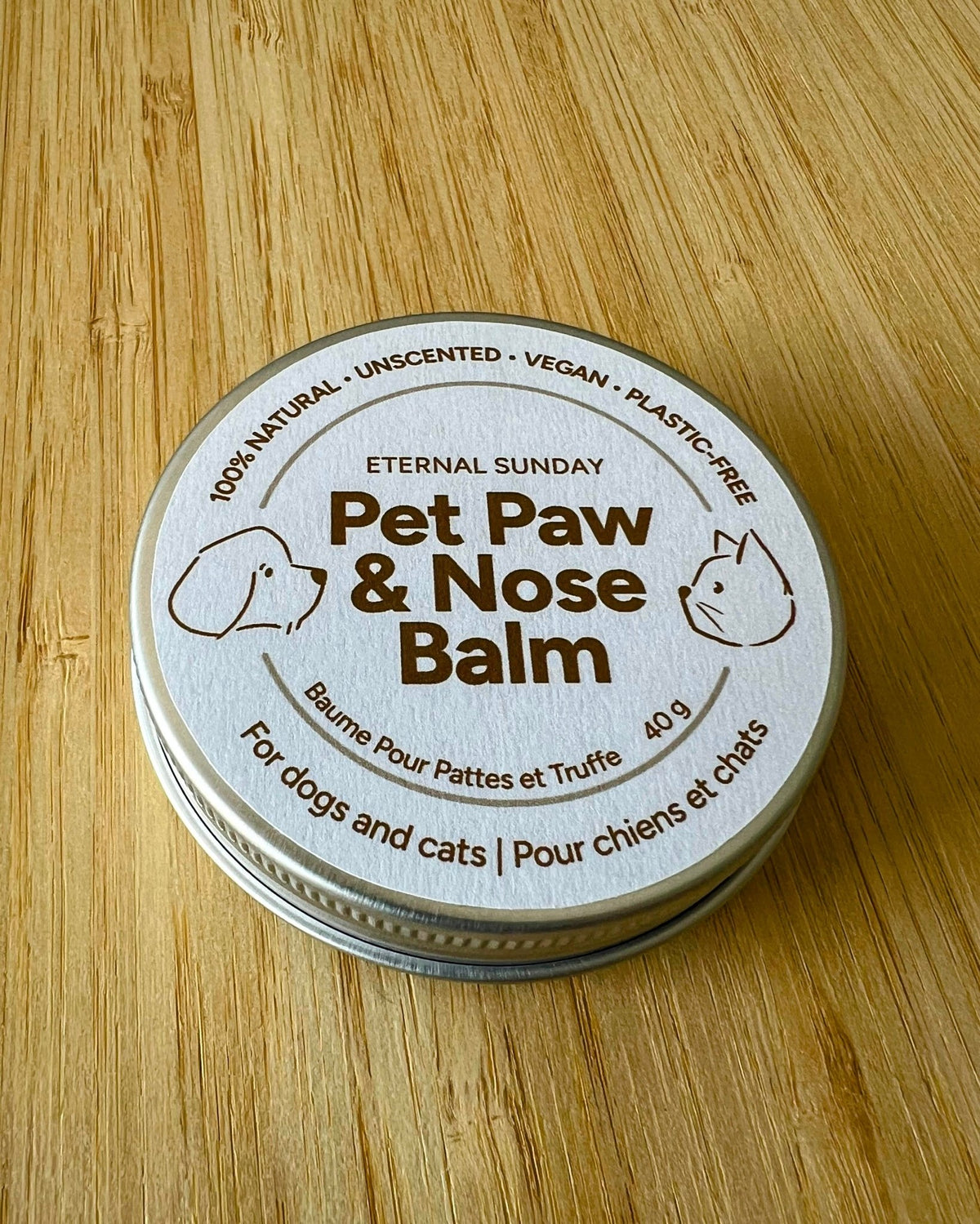
Paw & Nose Balm for Dogs and Cats
Some of our favourite customers walk on four feet, and this paw balm is for them. We made it the way we make everything at Eternal Sunday, with a short list of food-grade ingredients you can read aloud, because dogs lick their paws and cats groom all the time.
Canadian-grown camelina oil and rice bran oil condition dry, cracked paw pads, colloidal oatmeal calms them, and candelilla wax holds a firm, satiny balm that will not melt in a coat pocket or leave greasy prints across your floor. A touch of arrowroot gives it a dry, matte finish that absorbs quickly, so there is less to lick off and nothing to wipe up.
It is completely unscented, with no added fragrance and no essential oils. That last part matters more than most balms admit: many botanical ingredients that are fine for dogs are not fine for cats, so we simply left them all out. It is a paw balm you can use on the dog, and on the cat who grooms the dog.
Use it before winter walks to protect paw pads from road salt, ice and dry air, before hot summer pavement, or on a dry nose whenever it needs it. Eight food-grade ingredients, nothing that needs a warning.
Handmade in small batches in Toronto, Canada, in a reusable, recyclable metal tin. 40 g.
How to Use
- A thin layer. Warm a little between your fingers and smooth onto paw pads or a dry nose. Less is more.
- Before the adventure. Apply before the walk, the garden patrol, or the great hallway expedition. It protects best when applied first.
- Then, a distraction. A meal, a toy, a chin scratch. Give it a few minutes to settle before the grooming committee reviews your work.
Patch test first: a small amount on one paw, then wait a day.
Ingredients
Camelina Sativa (Camelina) Seed Oil, Butyrospermum Parkii (Shea) Butter, Oryza Sativa (Rice) Bran Oil, Euphorbia Cerifera (Candelilla) Wax, Maranta Arundinacea (Arrowroot) Root Powder, Avena Sativa (Oat) Kernel Flour, Tocopherol (Vitamin E), Glycine Soja (Soybean) Oil.
ℹ️ Contains oats and soy. For external use on animals. Discontinue if irritation occurs. Consult a veterinarian for persistent concerns.


For the goodest dogs and cats
Get them ready for any adventure in any weather!
Eight food-grade ingredients
What you see is what you get. Nothing artificial. No petroleum derivatives.
No essential oils
Which is why it is safe for both cats and dogs.
Plastic-free
A metal tin that can be reused, then recycled. No tube, no wrap.


about this product
Frequently Asked Questions
Is it safe if my dog or cat licks it?
Yes, and we designed the whole formula around the assumption that they will.
Dogs lick their paws. Cats groom every part of themselves and often each other. Any balm applied to a paw pad or a nose is going to be eaten sooner or later, so the only sensible approach is to make one entirely from ingredients that are safe to swallow. Every ingredient in this balm is food grade: camelina oil, shea butter, rice bran oil, candelilla wax, arrowroot powder, colloidal oatmeal, vitamin E and a small amount of soybean oil that carries the vitamin E. There is nothing petroleum-derived, no mineral oil, no petrolatum, and no preservatives.
The part that matters most, and the part most balms gloss over, is that we use no essential oils and no botanical extracts at all. This is the single biggest difference between a balm that is genuinely safe for cats and one that is only safe for dogs. Cats lack an efficient liver pathway for clearing certain plant compounds, particularly phenols and terpenes, which is why so many pet balms that are perfectly fine for dogs carry a "not for cats" note somewhere in the fine print. Chamomile, calendula, lavender, tea tree, lemongrass and rosemary essential oil all appear in popular paw balms. We left every one of them out. That means the ingredient list is shorter and less exciting, and it also means we do not need a disclaimer.
Some balms take a different route and add a bitter agent so the animal is discouraged from licking. We have not done that either. There is nothing in this tin that needs a deterrent.
One practical note: because it is a fat-based balm, an animal that licks off a very large quantity in one go could get a mildly upset stomach, the same as they would after any unusual amount of oil. A thin layer is all that is needed, and applying before a walk or a meal gives it a few minutes to settle. As with any new product, do a patch test first: apply a small amount to one paw and wait a day before using it more widely.
Will it leave greasy marks on my floors?
This is the complaint that comes up most often about paw balms, and it is the specific problem this formula was built to solve.
Most balms are made from soft oils and butters held together with a modest amount of wax. Coconut oil, olive oil and shea are all slow to absorb, so the balm sits on the surface of the pad, transfers onto whatever the animal walks across, and leaves visible prints on hardwood, tile and laminate. It is common enough that several well-known brands quietly recommend keeping their balm to outdoor use only, or wiping paws down when the dog comes back inside.
We approached it from three directions. First, the oils are chosen for how quickly they absorb rather than how rich they feel: camelina and rice bran are both light, fast-absorbing oils rather than heavy occlusive ones. Second, the wax fraction is high, using candelilla at a level well above what a lip balm would use, so the balm is firm and forms a thin film rather than a slick. Third, and most importantly, arrowroot powder is blended into the balm. Arrowroot is a fine, food-grade starch that absorbs surface oil and leaves a dry, matte finish, and it is the reason the balm feels powdery rather than slippery a minute after application.
The result is a balm you can use indoors. It still needs a moment to settle, so the sensible routine is to apply it and then give your dog or cat something to do for a few minutes. But you should not be finding a trail of paw prints across the living room, and there is far less on the pad for them to lick off.
When should I use it, and how often?
There are three situations where a paw balm earns its place.
Winter. Road salt, de-icing chemicals, packed snow and dry indoor heating all take moisture out of paw pads, and salt in particular is abrasive and irritating. Applying a thin layer before a walk puts a protective film between the pad and the ground. When you get home, wipe the paws with a damp cloth to remove any salt that has collected, and reapply if the pads look dry. In a Canadian winter, daily use through the salt season is reasonable.
Summer. Hot asphalt and concrete are hard on pads, and rough trails, gravel and sand wear them down. The same thin layer before heading out helps. Balm is not a substitute for common sense about surface temperature, though: if the pavement is too hot for the back of your hand, it is too hot for paws, regardless of what you have applied.
Dry noses and general dryness. Some dogs, particularly flat-faced breeds, get persistently dry or rough noses. A small amount smoothed onto the nose conditions the skin. The same goes for dry elbows and any rough patch of skin.
Outside those situations, two or three times a week is plenty for general conditioning, or simply whenever the pads feel rough to the touch rather than supple.
How to apply: warm a small amount between your fingers so it softens, then rub it into the pad, working between the toes if your dog will tolerate it. Less is more, and a 40 g tin goes a long way at that rate.
One boundary worth being clear about: this is a conditioning and protective balm, not a treatment. If pads are cracked and bleeding, if there is limping, swelling, discharge, persistent licking at one spot, or a nose that is crusting or losing pigment, that needs a veterinarian rather than a balm. Thickened, overgrown pads in particular can be a sign of an underlying condition that is worth having looked at.
What exactly is in it, and why so few ingredients?
The full list is eight items, and it is printed on the bottom of the tin:
Camelina Sativa (Camelina) Seed Oil, Butyrospermum Parkii (Shea) Butter, Oryza Sativa (Rice) Bran Oil, Euphorbia Cerifera (Candelilla) Wax, Maranta Arundinacea (Arrowroot) Root Powder, Avena Sativa (Oat) Kernel Flour, Tocopherol (Vitamin E), Glycine Soja (Soybean) Oil.
Camelina oil is the base. It is pressed from an ancient oilseed now grown on the Canadian prairies, a hardy, low-input crop that needs little water or fertiliser. It is rich in omega-3 fatty acids and naturally high in vitamin E, which makes it unusually stable for an oil of that type, and it absorbs quickly.
Shea butter, in its ultra-refined form, gives the balm body and conditions the skin without the nutty smell of raw shea, which matters on a product going near a nose far more sensitive than ours.
Rice bran oil is a light, dry-feeling oil, a byproduct of rice milling, and it keeps the balm from feeling heavy.
Candelilla wax is what makes it firm. It comes from a desert shrub, and it is the vegan alternative to beeswax. We use it at a higher percentage than you would find in a lip balm, so the balm holds its shape in a coat pocket or a warm car.
Arrowroot powder absorbs surface oil and gives the finish its dry, matte quality.
Colloidal oatmeal is finely milled whole oat flour, long used in skincare for dry and sensitive skin. It contains beta-glucans and avenanthramides and forms a light, comforting film.
Vitamin E is a natural antioxidant that slows the oils oxidising, which is what keeps the balm fresh. It is worth being precise here: vitamin E is an antioxidant, not a preservative. This balm contains no water at all, and a product with no water does not need a preservative system. That is one of the quiet advantages of an anhydrous balm, and it is why you will not find phenoxyethanol or any similar ingredient in this tin, even though several balms marketed as fully natural do contain them. The vitamin E we use comes suspended in a small amount of refined soybean oil, which is why soybean oil appears at the end of the list.
As for why the list is short: every extra ingredient is either something we would have to justify or something that narrows who can use the product. Honey would make it non-vegan. Calendula or chamomile would rule out cats. Botanical extracts would push us toward claims we are not willing to make. Eight ingredients, each doing a specific job, is what was left once we removed everything that was there for the label rather than for the animal.
The balm is unscented, vegan, palm-free, and made with gluten-free oats. It contains oats and soy.
Will it melt, how should I store it, and how long does it last?
The balm is deliberately firm, noticeably firmer than a lip balm. Candelilla wax has a high melting point, and at the percentage we use it the balm holds its shape through a Toronto summer, in a coat pocket, in a bag, or on a market table in August. It will soften if you leave it in direct sun or in a parked car on a hot day, and if that happens the balm may set again with a slightly different surface texture, which affects how it looks rather than how it works.
Store it somewhere cool and out of direct sunlight, with the lid screwed on. Room temperature is fine. There is no need to refrigerate it.
The best before date is twelve months from the batch date, and both the lot number and the best before date are printed on the bottom of the tin so you can always tell how old your tin is. Twelve months is a conservative figure. The limiting factor in any anhydrous balm is oxidation of the oils rather than microbial growth, and the vitamin E is there to slow that down. If a balm has gone past its best, you will smell it: oils that have oxidised develop a sharp, crayon-like or putty-like smell quite unlike the faint, neutral scent of a fresh tin. Since this balm is unscented, that change is easy to notice.
A 40 g tin lasts a long time in normal use. Applied thinly to a medium-sized dog before winter walks, most people find one tin covers a full salt season with plenty left over. Used occasionally on a dry nose, it will outlast its best before date, so it is worth buying one tin at a time rather than stocking up.
The tin itself is aluminium, so when the balm is finished it can be washed out and reused, or recycled. There is no plastic anywhere in the packaging: no tube, no plastic lid, no shrink wrap.